Some of my favourite photos

Thursday, 20 August 2015

Stoke Gabriel, Devon and Land's End, Cornwall

The Mill pond in Stoke Gabriel is one of my favourite places to go when we are down in Devon. It is a tidal Mill pond that has a dam across it, filling each time the tide comes in.
It is a great place to see waterbirds.
It was fascinating to watch this Heron really slowly creep around knee high in water after fish.


Banksy - Rat with camera - in Babbacombe

The photo of this Buzzard was taken at The Eden Project. Over the outer edge of the old Quarry there were 5 or 6 Buzzards riding on the thermals.


The Jackdaws and Rabbits at Landsend are so used people walking past them every day that they were very easy to take photos of.


Tuesday, 18 August 2015

A coastal path walk with Peregrines

We started our Coastal path walk at Brownstone car park, as soon as I stepped out of the car a cold breeze flew into my face, the sun was out but it was difficult to feel the warmth through the wind.
Bird's were tweeting from every direction especially a distinctive call of a Peregrine coming from down the hill where we were heading.
After reaching Daymark Tower a Peregrine came swooping down over the treeline only meters away from the grass, gliding as it flew.
The Peregrine flew into the opposite field, it was joined by two others which were all flying in different directions. A couple of times they came together, crying into the wind.
After a few encounters one of the Peregines flew in the direction to Newfoundland Cove, the other flew straight to Froward cove and the last Peregrine headed out to the cliff face. 


Daymark Tower


On arriving at the lookout post, lots of squawking could be hearded. Suddenly a Raven appeared over the tree tops followed by a Peregrine chasing it.
We knew that it was a Raven because of it's distinctive deep call - Cr-r-ruck.
The Raven tried to lose the Peregrine by swooping and diving thougth the trees whilst the Peregrine  kept dive bombing the Raven.
Looking at the photos you can see the size difference with the wing span of the Raven averaging 130cm and the Peregrine being smaller at around 110cm
Eventually the Raven and Peregrine flew behind the trees still fighting.


Half way along the coastal path we stopped to listen to the obvious sound of chicks calling as a parent approaches. It was the Peregrine who flew in and disappeared into the ferns on the cliff face. A few seconds later it reappeared, flew off and return 3 or 4 more times while we sat and watched.
The Peregrine doesn't build a nest, but scrapes a shallow hole called an Eyrie in grass or earth on a cliff face.
Even looking through my binoculars I couldn't make out the chicks as they were so well hidden.


The walk along the coast was extremely challenging as some parts had to be done on hands and knees, but it was worth it for the views of the coast, the Peregrines, the seals and the exercise!

Outer Froward point


Sunday, 16 August 2015

A friendly seal in Devon

Each year we go to the same beach in Devon to see a couple of friendly seals.
Two years ago there was a huge bull seal nicknamed 'Sammy' by the local people who was very used to being hand fed and having people in the water with him. There was also a much younger, smaller seal that had a pale underbelly with dark spots.
Last year when we went to visit them both seals were around, but there were lots of people jumping off the end of the breakwater so the seals stayed well away from the shore.
This year the older, bigger seal was not around on the day we went down, although somebody on the beach did say that 3 seals are there most days.
The seal we went in the water with was the young, small one from two years ago although it is not so small any more.
We kept our distance from the seal and let him swim close to us if he wanted to. He was quite curious and came over to us, but then went back to the breakwater where he was being fed by the fishermen.
'Sammy's' main diet should be fish and crustaceans but unfortunately we watched him being fed chips and other takeaway food.


As the tide came in so did lots of Compass jellyfish (Chrysaora hysoscella). These jellyfish do sting, but we had full wetsuits and gloves on (and didn't get closer enough). Their diet is mainly plankton and they live to around one year.


Friday, 14 August 2015

Dolphin watching (Porpoises) at Berry Head in Devon

Last year we went dolphin watching in Cardigan Bay in Wales. 
When we decided to come to Devon this summer we looked up if there was anywhere that we might see dolphins from the shore.
Berry Head near Torbay seemed to have the best recorded sightings over the past month.
After researching last year that dolphins can be seen just before high tide we worked out that high tide at Berry Head would be 12.30pm on the day we were visiting.
We climbed up through the Nature reserve and sat down right on the cliff edge. The sun was shining and the sea was quite flat so it was easy to spot anything on the water. At first we noticed patches of sea weed and lots of jellyfish floating past.
Roughly around 12.45pm we saw what we thought was 3 Common dolphins, over the next 30 minutes we watched a group of 3 and a group of 2 go back and foward around the buoys in front of us.
On looking back at the photos I think they look more like Harbour Porpoises as they have shorter snouts.
These photos are right at the end of my lens


Wednesday, 5 August 2015

Photogenic hare

I spent the morning hiding behind a hay bale taking around 70 photos of this hare. 
He/she came out of the tall maize, had a few long stretches, scratched behind its ears, washed a bit, then sank down into a form. 
I thought that was going to be it but the hare got up after a few minutes, looked around, scratched again, hopped about nibbling at the small shoots of grass that are coming up between the stubble. 
After an hour or so the hare disappeared back into the maize.
I'm quite pleased with some of the photos.


Tuesday, 4 August 2015

A quick walk around the field and flying ants

After tea this evening we went on a quick walk around the field. I am always amazed at how much wildlife can be seen.
The local farmer has spent the last couple of days cutting the wheat field and this evening 3 hares were out in the open.
In the hedgerow the birds hopped around before they settled down for the night and two deers stalked along the edge of the woods.
At the moment the most we see of the badgers is a rustle in the grass or a glimpse of dark grey running across an open patch.


The blackberries and elderberries are ripening, we ate a handful of blackberries on the way home.


Back in our garden the whole of the area around our bug hotel is moving with ants. The flying ants come out of the ground, climb to a high spot and take off in to the air.
When I tried to look up information on flying ants all I could find was articles about how to get rid of them, which I don't want to. They are only around for a few hours then all that is left is a pile of fine soil.


Sunday, 2 August 2015

Borrowing a camera with macro lens

My Grampy lent my sister a camera with a macro lens, so I thought I would have a go with it.
I started off in the garden taking a couple of photos of butterflies, then took the camera out in to the field next door.

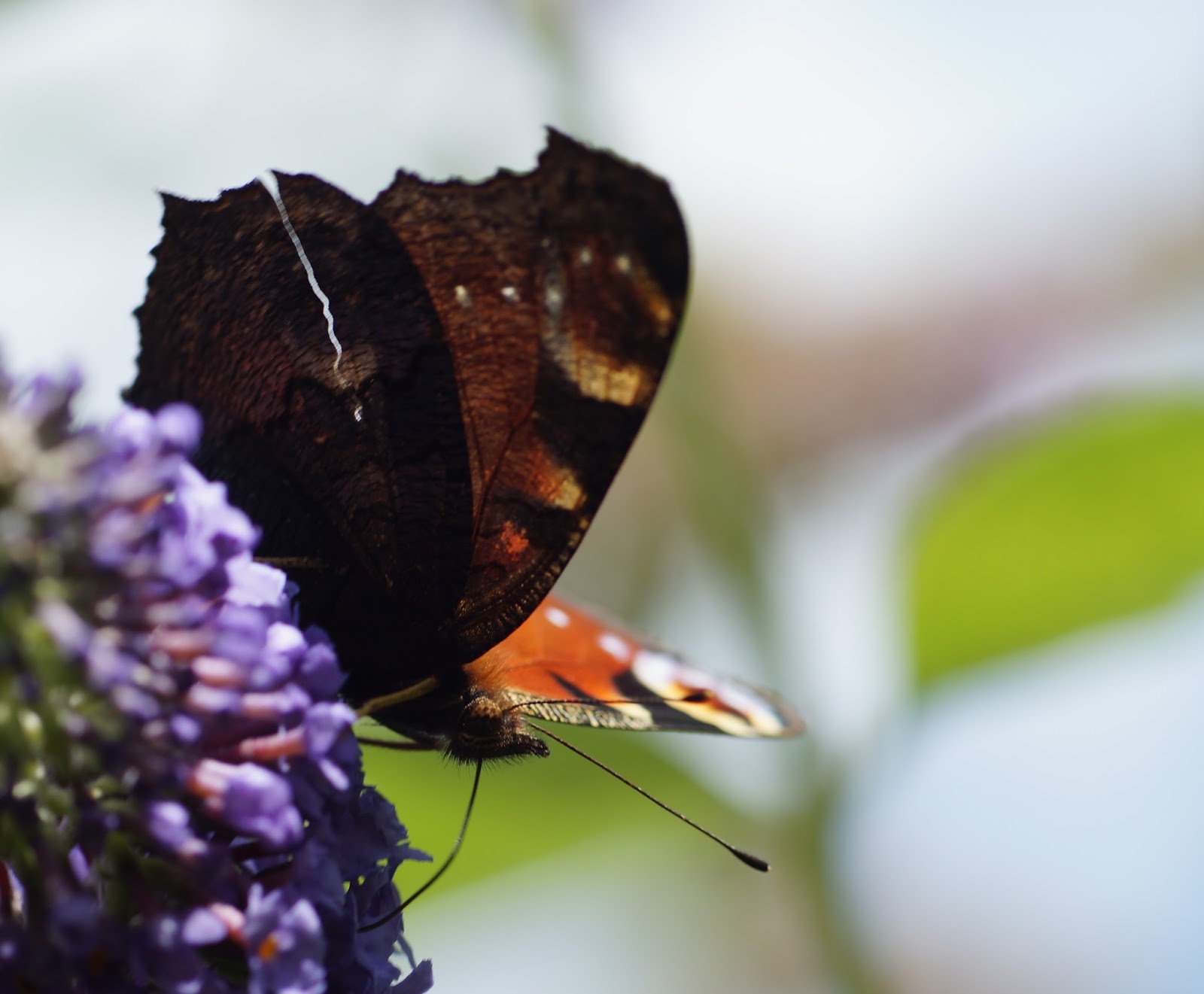
Peacock butterfly


Comma buttefly


Out in the field the sky is full of thistle down. As the wind catches the seeds they float towards the East like flakes of snow.


Down inbetween the plants, tiny threads of spider web shine in the sunlight as they stretch across the gaps.  
Here the sticky strands trap unsuspecting flies, bees and the odd ladybird where the poor insects will become a spiders meal.

A bee and a spider


 Some of the flowers that were fully open, at the top of the plants, appeared to be the most popular with sometimes two or three bees or hoverflies trying to get to the nectar.